Nobody Warned You About This Part: When Blended Families Cross Borders Too
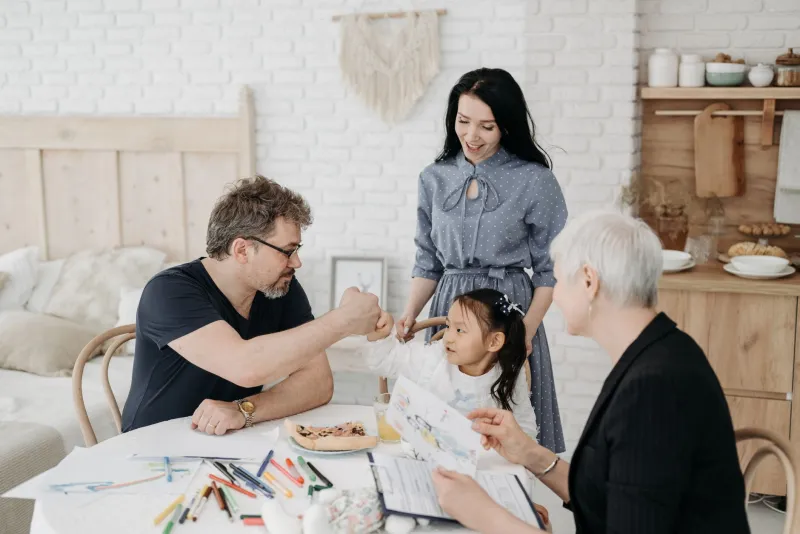
You did everything right. You took your time, you video-called for months, you flew out to meet her, you met her family. Maybe she met yours. The connection was real, the feelings were undeniable, and you started imagining a future together. What you probably didn't spend enough time imagining was what happens when your kids and her kids are suddenly expected to become a family — and everyone's still figuring out what that even means.
Blended families are hard. Full stop. The research on stepfamily dynamics has been consistent for decades: it takes an average of four to seven years for a blended family to stabilize. Four to seven years. And that's without a language barrier, a 6,000-mile move, or a child who's grieving a life left behind in another country.
This is the part of international relationships that doesn't get talked about enough.
The 'They'll Adjust' Myth
One of the most common assumptions people make — and one of the most damaging — is that kids are resilient enough to just roll with it. "They'll adjust." "Kids are adaptable." "Once they spend time together, they'll be fine."
Sometimes that's true. Often, it isn't — at least not on the timeline adults are hoping for.
Children don't experience transitions the way adults do. They haven't made the choice to be in this relationship. They didn't swipe right. They didn't spend months building emotional investment in this new person or this new family configuration. They're being asked to accept a massive change in their world because the adults around them fell in love. That's a lot to process for a ten-year-old — or a sixteen-year-old, which can actually be harder.
When international relationships involve children, there are often two separate sets of kids navigating two separate upheavals. Your kids are adjusting to a new woman in their dad's life, possibly one who speaks with an accent, cooks different food, and has different expectations around things like chores, respect, or dinnertime. Her kids — if they've relocated — are dealing with all of that plus a new country, a new school, new friends they haven't made yet, and the loss of everything familiar.
Expecting harmony in that environment isn't optimism. It's avoidance.
The Video Call Relationship Is Not a Real Relationship
Here's something worth sitting with: your kids have probably met your partner mostly through a screen. Maybe they've had a few video calls, exchanged some awkward hellos, maybe she sent them a gift for their birthday. That's sweet. It's also not a relationship.
Children build trust through shared physical experience — through watching someone show up consistently, through inside jokes that develop over time, through seeing how a person behaves when things go sideways. A video call can introduce a person. It cannot build a bond.
This means that when she arrives — or when you all move in together — the relationship between her and your kids is essentially starting from scratch, regardless of how long you've all technically "known" each other. The same is true in reverse. Your kids and her kids are strangers who've been told they're supposed to be a family.
Giving everyone permission to start slow isn't a failure. It's actually the only approach that has a real chance of working.
Parenting Style Clashes Are Real, and They're Cultural
This is where a lot of cross-cultural blended families hit a wall nobody anticipated. Parenting philosophies vary enormously across cultures, and what feels like "normal" discipline, boundaries, or expectations in one country can feel anywhere from puzzling to alarming in another.
In many Eastern European and Latin American cultures, for example, there's a strong emphasis on children showing visible deference to adults — not just parents, but any adult in the household. A child talking back or expressing disagreement openly might be seen as disrespectful in ways that feel extreme to an American parent used to encouraging their kid to "use their words."
On the flip side, American parenting culture — with its emphasis on independence, self-expression, and negotiating with children — can look chaotic or even neglectful to a partner who grew up in a more hierarchical family structure.
Neither approach is wrong. But if you two haven't explicitly talked about where you align and where you differ, you're going to find out the hard way — usually in the middle of a conflict involving a kid who's already stressed out.
Have these conversations before anyone moves in. Be specific. What happens when a child is disrespectful? Who disciplines whom? What's the expectation around chores, school performance, curfew? Where does your new partner's authority begin and end with your biological kids, and vice versa?
Her Kids Are Grieving Too — Even If They Seem Fine
If her children have relocated to be with you, pay attention to what's underneath the surface. Kids who've left their home country often perform okayness for the adults around them because they sense that the adults need them to be okay. They don't want to be the reason this new life falls apart.
Watch for the quieter signs: withdrawal, drop in school performance, loss of interest in things they used to love, irritability that seems disproportionate to the situation. These aren't behavioral problems. They're grief responses.
Creating space for her kids to miss their old life — without that missing being treated as a rejection of the new one — is one of the most important things you can do. That might mean finding a local community that shares their cultural background, keeping up holiday traditions from their home country, or simply asking them what they miss and listening without trying to fix it.
Building the Love Story Takes Time — and That's Okay
Here's the reframe that might actually help: stop thinking of family harmony as a destination you're trying to reach. Start thinking of it as a relationship that's being built in real time, with its own pace and its own milestones.
Your kids don't need to love your partner by the end of the first month. They need to feel safe around her, gradually. They need to see that she's consistent, that she's not going anywhere, and that their relationship with you isn't being displaced. That trust is built through a hundred small moments over months and years — not through one grand gesture or one perfect family dinner.
Same goes for her kids and you. Don't try to be their dad. Try to be a reliable, warm adult in their lives who shows up. Let them set the pace for how close they want to get.
And the two sets of kids? Give them time and low-pressure shared experiences. Road trips. Cooking together. A shared video game obsession. The bond they build, if you let it happen organically, will be more durable than anything you try to engineer.
What You Actually Need to Do Before Anyone Moves In
If blended family life is in your near future, a few practical things matter more than most people realize:
Get a family therapist involved early — ideally before the transition, not after things fall apart. A therapist who has experience with blended families and cross-cultural dynamics is worth their weight in gold.
Talk to your kids honestly about what's coming, at an age-appropriate level. Don't oversell it. Don't promise them they're going to love this. Tell them it might feel weird at first, and that's okay.
Create one-on-one time — you with your kids, her with her kids, and eventually you with her kids and her with yours. The whole-family dynamic is important, but so are the individual relationships.
Don't force milestones. The first "I love you" between a stepparent and stepchild should never be scheduled. If and when it comes, it'll mean something. Pushing for it just creates pressure that backfires.
The international part of your love story is genuinely beautiful. The cross-cultural part is genuinely complicated. And the family part — the messy, slow, sometimes heartbreaking, sometimes surprisingly wonderful part — is where the real story actually lives.